Updated October 2026.
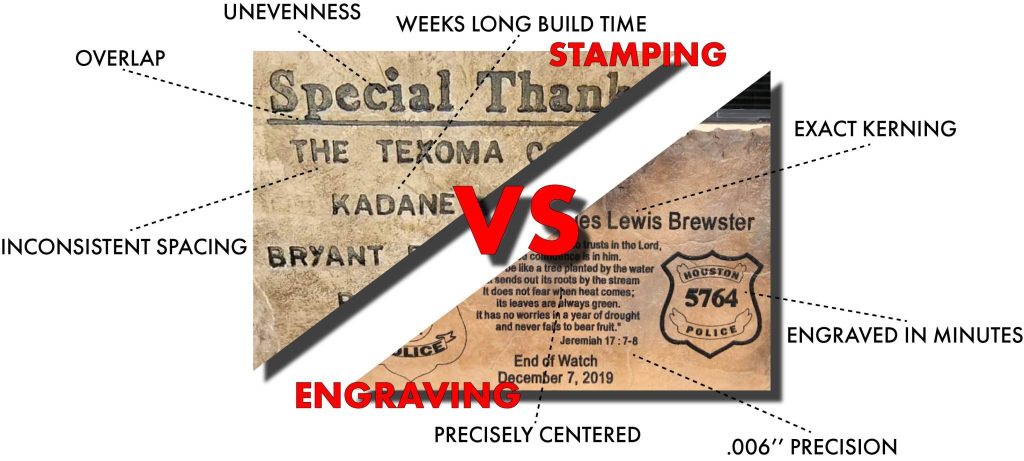
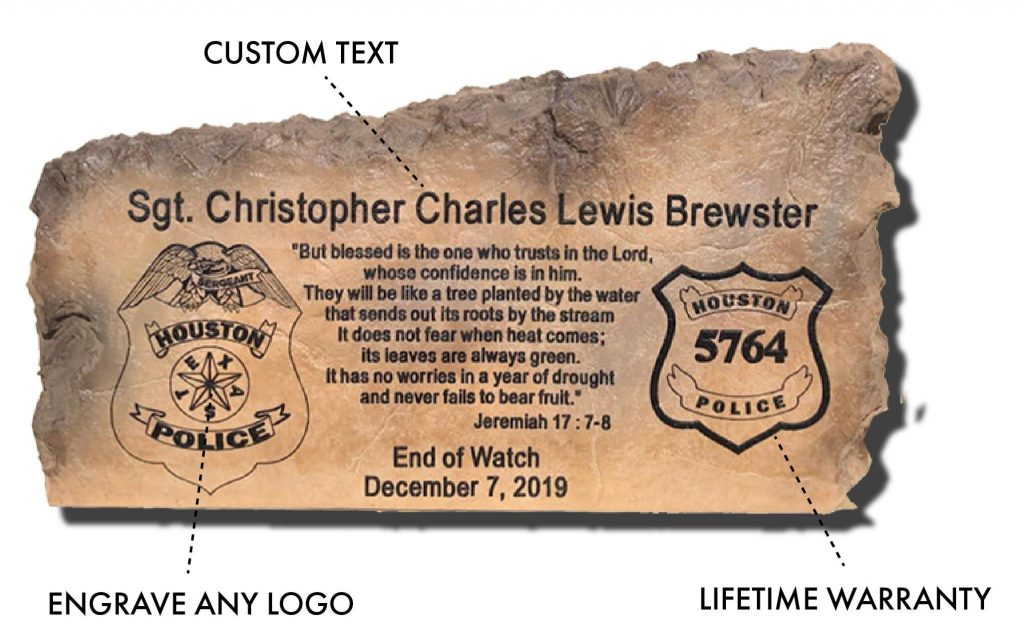
Short answer. Stamping presses a texture into wet concrete during the pour; it can’t put a logo or a name on concrete that already exists. Sandblasting cuts through a stencil with abrasive media; it needs masking, containment and silica-dust controls, and it struggles with fine lettering. CNC engraving with the RedArt CNC Pro cuts an approved vector design into cured concrete, stone, boulders or a wall, on site, with a diamond bit under a vacuum, at a programmed depth, with detail down to 0.006". Different tool, different product, different price point.
1. Stamped concrete
What it is. Rubber or polyurethane mats pressed into fresh (plastic) concrete to leave a repeating pattern: slate, flagstone, brick, wood plank. Color comes from hardener and release agent; a sealer protects it.
Where it works. New patios, driveways and pool decks where the client wants a textured look across the whole slab.
Where it fails.
- It only happens during a pour. Existing concrete can’t be stamped without demolishing it or pouring a stampable overlay on top.
- It is pattern, not content. A stamp can’t carry a company logo, a donor’s name, a compass rose or a QR code at readable detail.
- Timing is unforgiving. Once the slab sets there is no going back and no proof to approve first.
- Maintenance. Stamped color and sealer wear and need re-sealing; the impression itself is shallow.
2. Sandblasting (abrasive blasting)
What it is. A rubber “sandblast resist” stencil is cut, adhered to the surface, and abrasive media is blasted through the openings under air pressure to erode the exposed stone or concrete.
Where it works. Monument lettering in a shop, large simple shapes, surface texturing.
Where it fails.
- Consumables and prep: stencil material, adhesive, blast media, blast pot, compressor, respirators and cartridges, containment.
- Dust. Abrasive blasting is a recognized respirable-dust hazard. When silica sand is the abrasive it generates respirable crystalline silica regulated under OSHA’s construction silica standard, 29 CFR 1926.1153; NIOSH has recommended since 1974 that silica sand be prohibited as a blasting abrasive. On a school campus, in a cemetery or on an active job site, that means ventilation, exposure controls, PPE and cleanup.
- Detail. Edge fidelity is limited by how finely the stencil can be cut and by blast spread. Small serif text, thin lines and photographic detail are hard or impossible.
- Depth control is operator-dependent, so repeatability across a long run of lettering is poor.
3. CNC engraving (RedArt CNC Pro)
What it is. A portable 3-axis CNC frame placed directly on the surface. A standard trim router with a diamond-impregnated bit follows a toolpath generated from the client’s vector file (logo, lettering, art, CAD). The operator stands; the machine cuts.
What it does that the others can’t.
- Works on existing, cured concrete and stone, horizontally or vertically. No demolition, forming or new pour.
- Content, not just texture: logos, lettering, line art, 2D/2.5D relief, photographs converted to vector, donor names, wayfinding, QR codes.
- Detail down to 0.006" (0.15 mm); programmed, repeatable depth of about 1/32" per pass, up to 2".
- Uneven surfaces: the floating Z-axis rides boulders, stamped and textured concrete.
- Any size: 24" × 36" per setup (24" × 72" with rail extensions), tiled with datum points and a raised “ghost pass” to verify alignment before cutting.
- Low dust: cuts wet or dry with a vacuum attachment; no stencils, no blast media, no blast pot. Most jobs finish in an afternoon with little cleanup.
- Proof first: the design is approved on screen before anything is cut, and the file can be adjusted on site.
- Finishes: natural recess, pigment or stain, or epoxy/polyaspartic inlay (high contrast, UV- and wear-resistant, polishable flush with the slab; glow epoxy for exit paths).
- Field-ready: 114 lb in a rolling case; runs on a standard 120V outlet or a 2,000W inverter generator; sets up and levels in minutes on four threaded feet.
4. Side by side
| Stamped concrete | Sandblasting | CNC Pro engraving | |
|---|---|---|---|
| Existing cured concrete | No (new pour or overlay) | Yes | Yes |
| Logos, names, fine text | No | Limited | Yes, 0.006" detail |
| Depth control | Fixed by mat | Operator-dependent | Programmed, repeatable, to 2" |
| Vertical surfaces | No | Yes, messy | Yes |
| Boulders / uneven stone | No | Yes | Yes (floating Z) |
| Dust and media | Low | High; silica controls | Low; vacuum, wet or dry |
| Consumables | Mats, hardener, release, sealer | Stencil, adhesive, media, PPE | Diamond bits (~$40, 5–10 hr) |
| Approve before cutting | No | Stencil only | Yes, on-screen proof |
| Permanence | Shallow impression, re-seal | Cut in | Cut in, optional inlay |
5. What this means for each buyer
- Property owners and businesses: your existing floor, patio or entry can carry your logo without tearing it out.
- Architects and landscape architects: engraved recognition, wayfinding and art become specifiable on existing hardscape, from your CAD files, with repeatable depth and documented specs.
- Municipalities and schools: permanent markings and donor programs on sidewalks, plazas and parks with no repainting cycle, no blast containment and no closure of the site for days.
- Engineers and facilities: in-house labeling, safety markings and QR codes that survive polishing and traffic.
- Entrepreneurs: engraving is priced on value, not square feet of texture. Published example jobs run from $300 pet memorials to $20,000+ municipal projects (individual cases; results vary).
See the CNC Pro
Explore the machine and full specification sheet, browse real projects, or book a 15-minute call with Henry, the inventor of the CNC Pro.
Sources